


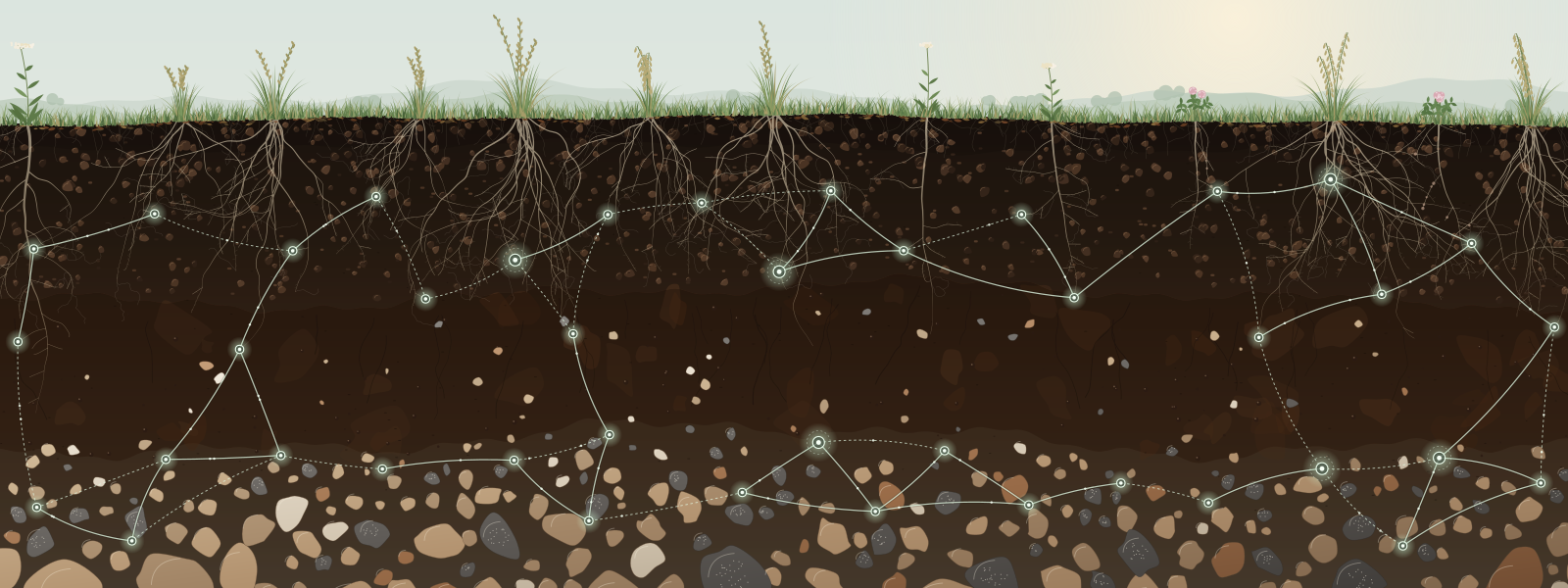
We study the soil carbon cycle — the largest carbon pool on land — by fusing mechanistic models, big data and AI, to find verifiable, gigaton-scale pathways for removing carbon dioxide from the atmosphere.
Soils hold more carbon than the atmosphere and vegetation combined, as both organic matter and inorganic minerals. How that carbon forms, how long it persists, and how it responds to a changing climate and to management remain open questions — and they stand between climate science and credible soil-based climate solutions.
The Soil Intelligence Lab, led by Feng Tao at the Asian School of the Environment, Nanyang Technological University, builds the process-guided AI tools, global data syntheses and models needed to answer them.
Research
Soil organic carbon
Formation, persistence, and responses to climate change.
02Enhanced rock weathering
Scalable, verifiable carbon dioxide removal.
03Cross-scale carbon cycle models
From soil columns to Earth system models.
04Process-guided AI
Interpretable AI and foundation models for biogeochemistry.
News
- 2026 The Soil Intelligence Lab opens at the Asian School of the Environment, NTU Singapore, supported by a Nanyang Assistant Professorship to build PASCA — a process-guided, AI-assisted soil carbon foundation model for verifiable carbon dioxide removal. We are recruiting!
- Dec 2026 Feng co-convenes two sessions at AGU 2026 in San Francisco: Advances in land carbon cycle modeling and Advances in soil carbon sequestration: processes, management, and scalable storage.
- Oct 2026 COUSINE, our coupled soil inorganic–organic carbon model for enhanced rock weathering, is accepted in Journal of Advances in Modeling Earth Systems.
- Jul 2026 BINN v1.0, our Biogeochemistry-Informed Neural Network for soil organic carbon, is published in Geoscientific Model Development, covered by the Cornell Chronicle.
Selected publications
- Optimizing carbon dioxide removal in agricultural soils: A new mechanistic model of enhanced rock weathering Journal of Advances in Modeling Earth Systems (accepted)
- Biogeochemistry-Informed Neural Network (BINN v1.0) for improving accuracy of model prediction and scientific understanding of soil organic carbon storage Geoscientific Model Development 19(14), 6777–6795
- Scientifically-Interpretable Reasoning Network (ScIReN): Discovering hidden relationships in the carbon cycle and beyond Proceedings of the AAAI Conference on Artificial Intelligence 40(45), 38441–38450
- Microbial carbon use efficiency promotes global soil carbon storage Nature 618, 981–985 ★ Best Student Paper, Sino-Ecologists Association Overseas (Sino-Eco) 2023